

Editor’s Note: This essay by Rabbi Address originally appeared in the July 23, 2025 issue of the Jewish Community Voice of Southern New Jersey.
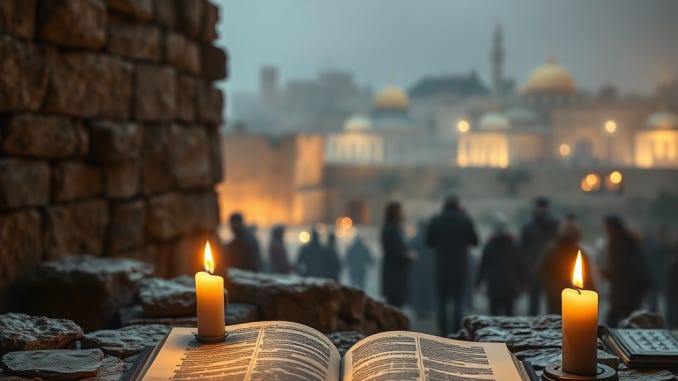
This year, Tisha B’Av (the ninth day of the month of Av), will fall on August 3. Tisha B’Av, according to classic Biblical tradition, commemorates the destruction of the Temples in Jerusalem as well as other calamities, such as the Bar Kochba Revolution and the various historical expulsions from countries, such as Spain. In addition, as time has progressed, it is also an occasion to remember the Shoah and other more current catastrophic events. This is a fast day that may have its basis in a passage from Zechariah 8:19, which records the fast day of the “fifth” month. Likewise, it is tradition to read from the Book of Lamentations during services.
There are other traditions that surround this day, depending on the community in which you reside and worship. For many contemporary Jews, this day represents a challenge, for, to be honest, how many of your friends and neighbors mourn for the destruction of the ancient Temple? Now there are groups within the world-wide Jewish community that do mourn for the Temple and pray for its’ restoration, however, the vast majority of us do not. It is a challenge to promote the knowledge and observance of Tisha B’Av in modern American Judaism, especially when, during the course of the year, we do have observances that focus our attention on the wide variety of historical tragedies that have befallen us, especially after October 7.
We are, as you know, a people of history. We struggle with trying to make meaning out of what has happened to us as a people. So, let me suggest that this year, maybe we can take this Tisha B’Av and reflect not only on what we have lost as a people throughout history, but what we may have lost as individuals. I am not reflecting on the loss of people, or relationships. Rather, I am suggesting that we may focus on what has been lost in these recent years because of global events. There has been, in a way, a loss of innocence. For those of us who came to maturity in the 1960s and 1970s, we remember the moments of the Six Day War, the Yom Kippur War when Israel emerged as victors and not as victims. Our relationship with Israel was forged in those days, often resulting in a multi-generational bond that manifested itself in numerous trips and financial support.
Have we lost that? How many of our children and grandchildren share that same relationship and commitment? There is an increasing generational divide in our community over the role and status of Israel, and to deny that reality is to ignore how much has changed. We have done a very bad job in educating our younger generations on our history, the history of Israel and the geo-political realities of the modern world. How many of our congregations and organizations have sponsored on-going inter-generational dialogues on Israel? We can mourn the loss of meaningful education.
We can also mourn that uncomfortable reality that so much of the current wave of antisemitism has been met with silence from so many people that we thought of as allies in the fight for social justice. From October 7 on, so many colleagues and Jewish communal leaders have voiced frustration over a lack of support from individuals and groups that we marched with and supported in previous years.
Are we, as Bilaam emoted in the Book of Numbers, still “a people apart?” The discussion on social media, articles and books now has begun to debate if, despite the promise of American equality, we as Jews are still, to many, the “other.” Perhaps we mourn the loss of that fantasy of total acceptance, and in doing so, can begin to take steps to reinvigorate our community to gain strength and spiritual fortitude from within. We may be seeing a wave of this as so many colleagues, across the denominational lines, have reported an increase in the number of people seeking to study and become Jews.
Finally, the confluence these changes has validated is the fact that the Jewish community of this country is experiencing radical change. We may mourn that loss of what was as we grapple with what may be. The Jewish worldview is literally being reshaped in front of our eyes.
Dr. Steven Windmueller, in a recent blog post in the Times of Israel, commented on this major change: “We have left the postwar framework where we built our lives, framed our beliefs, and understood the world that would shape our destiny for the past 80 years. This extraordinary and successful cycle, 1945-2025, delivered for us a coherent world view. That experience has now ended.” Change is part of our history as Jews. Right now, as we live this restructuring, we again are faced with amazing choices. After we mourn for what was, we face that challenge of moving on. What and how we choose will create the Jewish community for our children and grandchildren. Once again, the choices are ours.